
THE PEOPLE OF THE ANACONDA and THEIR YURUPARI LEGEND: Individual and Collective Lessons from the Amazon Jungle.
(English/Spanish)
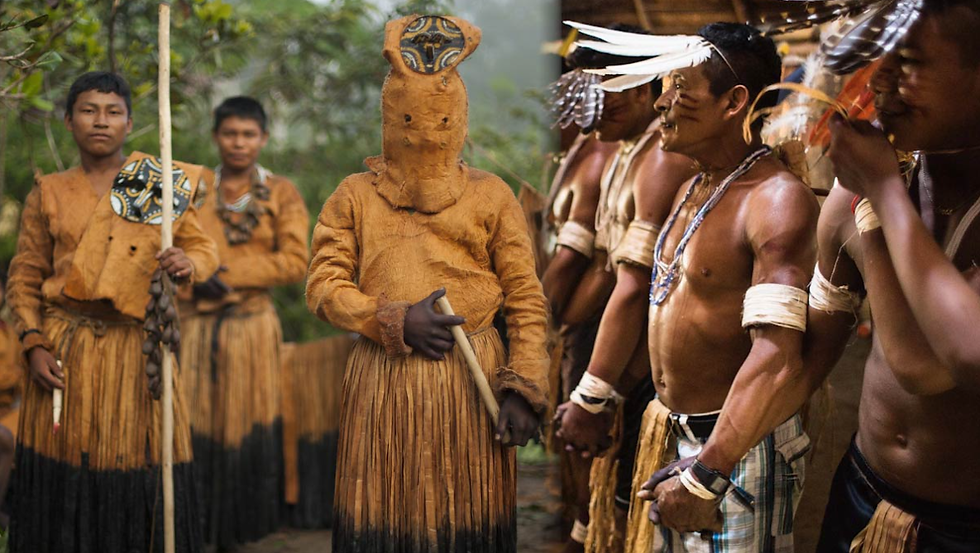
The People of the Anaconda (La Gente de la Anaconda), who live along the Pirá Paraná River in the Amazon, recount that the "songs of birds" gave rise to the flutes used in the initiation rites of young men in Indigenous communities. They also tell of the ancestral anaconda, who transformed into a human being and became embodied in the sacred trumpets and flutes employed during these initiation ceremonies in the Amazon jungle (Hugh-Jones, 1979; Orjuela, 1983).


There are several versions of the Yuruparí Epic and of its central figure, Yuruparí, whose story constitutes both a foundational myth and the basis of a sacred initiation ritual among numerous Indigenous peoples of the Colombian and Brazilian Amazon. The Yuruparí tradition is regarded not only as one of the great epics of the Americas but also as the name of the sacred ceremonial complex associated with these Indigenous tribes (Orjuela, 1982). Furthermore, the Yuruparí Epic has been recognized as a literary work of comparable significance to the Popol Vuh, the sacred text of the K'iche' Maya, underscoring its importance within the literary and spiritual heritage of the Americas (Orjuela, 1983).

The purpose of this article is to propose several hypotheses, from the perspective of Analytical Psychology (Jungian psychology), regarding Yurupari, his story, and its potential archetypal significance for individual and collective life, particularly in the context of the current climate crisis. Furthermore, this article explores, in general terms, the relationship between Nature and human beings, as well as the psychological development of the Indigenous nations of the Amazon. To accomplish this, I will examine the synopsis of the Yurupari narrative as retold by Héctor Orjuela (Orjuela, 1982).
To begin, Orjuela (1982) describes several versions of the mythical origin of Yurupari found among the Indigenous peoples of the Amazon. According to these traditions, Yurupari's birth is attributed to: (a) the fertilizing power of Thunder, the Sun, or a Creator Being; (b) the contact of a single woman—or a married woman whose husband was impotent—with fertilizing waters; (c) a Giant Cobra, Great Snake, or a Paye (shaman); (d) Thunder, who seduced a woman after she had eaten a forbidden fruit; and (e) a virgin who conceived after rubbing her body with a sacred plant while bathing.
FIRST
According to Orjuela (1982),
“Yurupari was born from a virgin mother who became pregnant under one of several circumstances: (a) after eating the pihycan fruit that monkeys—or a Paye (shaman)—threw to her from the top of a tree; (b) after drinking a significant quantity of cachiri (an intoxicating beverage); (c) after touching her intimate parts with uaú juice; (d) after scratching her face with a tobacco branch or leaf; or (e) through the assistance of a Paye.”
In many versions of the Yurupari narrative, the mother is described as having a closed or absent vagina and, therefore, as requiring an intervention in order to have a birth opening. This opening is performed by either of the following figures: Thunder, a fish, the elders of the community, or a Paye (shaman). The mother, understood as an astral being, is identified with the Pleiades.
Yurupari can be understood as the imaginal representation of an archetypal masculine figure rather than as the representation of a human being. This interpretation is supported by the fact that his mother was a virgin, a motif that parallels the birth narrative of the Virgin Mary in Christianity. The emergence and development of the Yurupari archetype may be associated with the Taitas or Mamos (Shamans) and their capacity to interact with the Spirit World. Through this connection, they provided the symbolic and psychic conditions necessary for the Feminine principle of the world to give birth to Yurupari.
The nourishment of Yurupari as an archetypal figure came from the fruit of a tree of the Collective Unconscious—the pihycan. Symbolically, Yurupari derives his life force from a tree - a psychic symbol of the Divine Spirit. Furthermore, the gift of tobacco enabled Yurupari to perceive and communicate with Spirits. From a Jungian perspective, this suggests the existence of an archetypal force within the human psyche that allows individuals to connect with the Invisible World—the Spirit World—and with the world of imagination, where symbols and images emerge. As a side note, the intrinsic ontological connection between Spirits and psychic Images is worth exploring in a future article.
The birth of this archetypal force occurred with the assistance of a fish; thus, Yurupari may be understood as the expression of a psychic content emerging from the Feminine principle. As Jung observed, “Theriomorphic [fish and snake] symbols are very common in dreams and other manifestations of the unconscious. They express the psychic level of the content in question” (Jung, Aion, para. 291). Therefore, the fish in the Yurupari myth may be archetypally understood as a symbol of the unconscious - a primordial psychic content emerging from the deep waters of the Objective Psyche.

SECOND
Orjuela (1982) continues:
“The boy, Yurupari, is separated from his mother by a) the payes (shamans) or other members of the tribe; b) the elders; or c) the Thunders, depending on the version of the myth. Yurupari grows rapidly, like a plant, free and invisible within the jungle. He resides inside the uaú tree, where his cries can be heard. His mother nourishes him by breastfeeding him without ever seeing him. When he reaches adolescence, he encounters his people, who wish to make him their Chief and present him with the cylindrical stone, a symbol of royalty and power. In other versions of the legend, Yurupari is born without a mouth and is therefore unable to speak or eat. The tribe sustains him by feeding him with the white smoke of tobacco. Later, a paye (shaman) or another individual opens his mouth, allowing him to speak (Orjuela, 1982).”
Yurupari, as a boy, symbolizes the emergence of the nascent masculine and the psychological movement of separation from the mother. He may also represent the potential initiation into masculine life and the gradual differentiation from an excessive identification with the feminine principle within the psyche of the adolescent male. However, Yurupari remains too young to undergo the complete initiation into mature masculinity. His separation from the maternal realm may therefore be understood as a preliminary stage, a preparation for a later initiation: the initiation of the ego into the realm of darkness, the world of the unconscious.
Furthermore, if the payes (shamans) are the ones who take Yurupari away, this separation may represent an initiation into the knowledge and experience of the World of Spirits. If, however, the elders are responsible for his removal, then, the separation may symbolize the transmission of ancestral knowledge: the laws of nature, cultural traditions, myths, and stories that teach him how to sustain both individual and communal life.
Moreover, what is the symbolic meaning of Yurupari’s rapid growth? It may suggest that the expansion of awareness and the development of consciousness accelerate the movement of unconscious contents toward consciousness. Within the archetypal realm, time and space do not operate in the same manner as they do within ordinary conscious experience. Thus, Yurupari’s accelerated growth may symbolize the timeless nature of archetypal processes, in which psychological transformation unfolds beyond the limitations of chronological time.
Then, the story mentions that Yurupari was invisible. From a Jungian perspective this may mean that he is not disturbed by human concerns, and that he just grows like a psychic content -an archetype- unaffected by human interactions. Therefore, the fact that Yurupari “grows in a tree” means that he is directly influenced by the Spirit Rector within, that is the Self or Great Spirit, who nourishes him.
The story further states that Yurupari was invisible. From a Jungian perspective, this invisibility may symbolize that he exists beyond the conscious limitations and disturbances of ordinary human concerns. He is a psychic reality, an archetypal image, deep with the Objective Psyche. Yet, as Jung wrote in Answer to Job, “Whoever knows God has an effect on Him.” Our conscious relation to archetypal contents may have an effect on Yurupari. Nonetheless, his growth occurs according to the autonomous dynamics of the unconscious and, to a greater extent, invisible to us.
Therefore, the image of Yurupari “growing in a tree” may suggest that he is nourished by a deeper spiritual principle within the psyche: the Spirit Rector, which in Jungian terms may be understood as the Self or, in a broader spiritual interpretation, the Great Spirit. This Great Spirit, as a tree, may provide Yurupari the guidance and nourishment of a transpersonal source.
As Yurupari comes into contact with human beings, or symbolically, as the ego encounters the archetype of separation and individuation, suffering emerges. In the epic, this is expressed through Yurupari's crying, which symbolizes the psychological suffering inherent in the ego's encounter with the archetypes. As Jung (CW 14, para. 778) observed, “...the experience of the Self is always a defeat for the ego.”
Furthermore, the story tells us that Yurupari is breastfed by his mother even though she never sees him. Breastfeeding symbolizes, from a Jungian perspective, the archetypal nourishment that flows from the Objective Psyche through images, symbols, and imagination. Thus, maternal consolation may arise when connecting with the archetypal mother whose nurturing presence is experienced through the positive side of the imaginal realm, while Yurupari remains hidden within the darkness of the tree - that is, within the Self.
Subsequently, upon reaching adolescence, Yurupari reveals himself to his people. Adolescence marks a period when the archetype related to separation and individuation gets intensely activated, which corresponds to the gradual separation and differentiation of the ego from the maternal aspect of the Self, enabling the ego to develop greater strength, autonomy, and identity.
Yurupari, as the archetypal force of separation and potential individuation, is chosen by the Collective Unconscious to embody the ruling principle -the King. In the epic, this is symbolized by the community’s selection of Yurupari as its king. Then, in the story, Yurupari is presented with a circular stone, which is a symbol of permanence that transcends the temporal limits of human life. Furthermore, the stone may psychologically represent the Self, the center and totality of the human personality. Thus, the circular stone signifies Yurupari’s role as the bearer of the Self and the potential “Chief” of the unconscious. Yurupari is also the representative of the Sun and the Great Spirit on this Earth.

THIRD
"The adolescent Yurupari is beautiful and extraordinary; he does marvelous things, and has a peculiar physical aspect. Sometimes his body is full of holes that produce music, or it is very hairy, which gives him a simian appearance; sometimes, light or fire pours out of his body as well as sounds of thunder. [Yurupari] is a messenger from the Sun, and he is looking for the perfect woman, a woman that is not intrusive, impatient, gossipy (unable to keep secrets), or intrusive, libidinous, and gossipy. Furthermore, [Yurupari] has legislative and religious missions and, in order to accomplish them, the Sun has given him a magical bag full of spells" (Orjuela, 1982).
“The adolescent Yurupari is beautiful and extraordinary; he does marvelous things, and has a peculiar physical aspect”: This sentence suggests that, as an adolescent, Yurupari is beautiful and extraordinary. He performs marvelous deeds and possesses a remarkable physical appearance. From a Jungian perspective, these qualities symbolize the fascination and admiration that the human ego experiences toward the archetype of separation and individuation embodied by Yurupari as he remains connected to the Divine.
The myth further states that, "...sometimes his body is full of holes that produce music, and he is looking for a perfect woman." Psychologically, music symbolizes an expression of the psyche that establishes a living connection with the Spirit World. Thus, Yurupari, as the archetype of meaning that mediates the relationship between human consciousness and the images and symbols of the Great Spirit, gives voice to the emotional and affective dimensions (music) of spiritual experience. At the same time, the music emerging from his body suggests the presence of a Feminine principle that, when connected with the Masculine principle, points toward the Mysterium Coniunctionis—the union of opposites. On the human level, this archetypal reality is outwardly expressed in a man's search for a woman with whom he may establish a meaningful and transformative union, reflecting the deeper psychological movement of Anima and Animus coming together to facilitate wholeness.
Then, the story stated the following: “[Yurupari] is very hairy, which gives him a simian appearance.” This description suggests that the Masculine principle is still in a highly instinctual, primitive, and animal-like state; in other words, the Masculine has not yet been fully humanized and differentiated from instinctual impulses. Thus, the legend of Yurupari teaches people about the gradual humanization and reasoning of the Masculine principle—the psychological movement from instinct toward reflection and reason, from an impulsive individual and society towards a more conscious, more individuated, and more rational individuals and society.
The story continues: “...Light or fire pours out of his body, and is a messenger of the Sun.” The heroic archetype of separation and individuation -Yurupari- has the potential to bring enlightenment to human beings. Furthermore, Yurupari’s fire reminds us that he was the son of the Sun and, as such, that his teachings convey the sacredness and wisdom of the Father Sun. As a messenger of the Sun, Yurupari brings an important archetypal message to the ego: the ego must undergo a process of humanization within the concrete world of human affairs.
Furthermore, Yurupari, as a symbol of the Masculine Force in the Universe, must eventually encounter and relate to its opposite, the Feminine. An idea or principle cannot remain purely abstract; it must acquire a body and become embodied in lived experience. In the concrete world of human affairs, this may be expressed by the process of a man establishing a relationship with a woman. Furthermore, In the intrapsychic realm, it may be understood as the male ego’s need to consciously relate to its contrasexual psychological counterpart -the Anima. Thus, the legend of Yurupari has the concrete and psychological goal of the encounter of the Masculine and the Feminine -a hieros gamos or Mysterium Coniunctionis- , leading towards individual and collective wholeness.
Furthermore, the magic bag of spells that Yurupari receives from the Sun refers both to Yurupari’s ability to establish contact with the World of Spirits and with the Collective Unconscious. In other words, Yurupari has the capacity to activate the archetypes of the Collective Unconscious, with which human beings also need to relate to in order to appease the Great Spirit or the Divine.
FOURTH
After receiving the cylindrical stone of the Moon -”Nanacy”- [Ocampo, 2019] and receiving instructions from it on how to govern, Yurupari began his civilizing mission. He produced thunder and fire. Then, he personally, or through a representative (a paye or a messenger), created laws, mandated fasting, taught how to plant corn and harvest the land as well as songs and dances for rituals. He became the primary guide of the dances during the ceremonial festivities. Women wanted to discover the forbidden secrets of the Yurupari ritual and, therefore, they spied on men. [Hence], Yurupari punished them (including his own mother) and turned them into stone. This was why he was [also] given the name of Bokan (the Bad Hearted). In order to refrain from inflicting more punishments and obtain full freedom, he ordered the building of a House of Stone, far away, at the banks of the Aiari River. [However], …some of his messengers betrayed him by revealing the secret to women" (Orjuela, 1982).
In order to guide human beings in their relationship with the World of the Spirits and with Nature, Yurupari, -the symbol of the archetypal force of the Masculine and the Masculine force of Separation and individuation- receives wisdom from the deepest aspect of the Feminine, represented by “Nanacy”, the cylindrical stone of the Moon.
The archetypal guidance on how to live life, in accordance with the Spirit World and Nature, emerges from a profound and deep relationship with the archetypal Feminine. According to the Yurupari legend, being “civilized” does not necessarily mean being strictly rational or educated; rather, it involves recognizing and integrating the Feminine in a balanced way, with the Masculine. From the perspective of Analytical Psychology, the masculine ego seeks the wisdom of the Anima (the Feminine) for the purpose of achieving psychological wholeness.
During childhood, human beings traditionally learn about the world largely through the perspective of the mother, that is, through the feminine. Consequently, a boy’s personality is initially shaped under the profound influence of the archetype of the Feminine. The purpose of a rite of initiation is to help an adolescent boy to more fully embrace the forces associated with the archetype of the Masculine. The secrecy surrounding initiation rites may stem from the belief that their potency depends upon maintaining a clear physical and psychological boundary between women and the initiated men as well as between the Feminine and the Masculine, thereby preventing what might be understood as “psychological contamination.” From this perspective, men are prohibited from learning and witnessing female initiation rites and vice versa.

FIFTH
"Yurupari, or his messenger, in an act of cannibalism, devoured children because they disobeyed him by eating the roasted fruits from the ua\u. Yurupari blamed the parents for the consequences of the disobedience. [Then,] the parents (or the elderly people) decided to take revenge and to plan his death" (Orjuela, 1982).
There is an archetypal tendency in human beings to unrestrictively and impulsively follow their own desires. In the story of the Yurupari, this is represented by the child who ate a forbidden fruit. Rather than developing the self-restraint necessary for psychological maturation, , the individual succumbs to unconscious impulses. In order to transcend this condition and move towards individuation and wholeness, the archetype of separation and individuation -Yurupari- restrain these infantile impulses from being enacted in consciousness (“eating the forbidden fruit”). Yurupari accomplishes this by devouring these impulses -that is, by "suppressing and repressing” into the unconscious, those infantile impulses and regressive tendencies.
Furthermore, the symbolic meaning of “parents being responsible for the disobedience of the children” may refer to the historical repetition, from one generation to the next, of a societal struggle between archetypal infantile regressive tendencies toward impulsivity and, on the other hand, the development of more mature ways of living. In other words, it reflects a collective, infantile tendency to regress toward the embrace of the mother (the unconscious) and a childish ways of thinking and living versus a more patriarchal and more mature masculine mode of living and being. The latter represents a more individuated society in which values such as balance, reason, relationality, mutuality, individuality and collectivity prevail.
SIXTH
"[Then, the parents or the elderly] invited Yurupari to a party, even though he knew they wanted to kill him. During that event, Yurupari vomited the children. They got him drunk and, then, they threw him into the fire. The bonfire, made of dry Inga leaves, is the only fire that can kill him. From his ashes sprout the pachuba palms, which grow rapidly. Up them, Yurupari ascends to the heavens. From the ashes, too, emerge evil spirits, as well as the first poisonous plants and animals. His entrails produce flies and serpents. This sacrifice is followed by a great conflagration: the vegetation burns, and after a long time, one must sow in the ashes. The people scatter in different directions" (Orjuela, 1982).
There is a regressive tendency within the unconscious to undermine the heroic archetypal impulse of the ego to separate itself from the unconscious. In the story, this tendency is symbolized by the parents' desire to kill Yurupari. Furthermore, as a consequence of this destructive tendency, the psychological problem of impulsivity repeatedly remerges in human life. This recurrence is symbolized in the story by the reappearance of children, represented by “the vomiting of children.”
Then, in the next cycle of life, the archetype of separation and individuation (Yurupari) is activated once again in both the individual and the collective psyche. At the same time, the regressive forces of the unconscious, symbolized by the parents wanting to kill Yurupari, reappear. One could argue that, with each cycle, these regressive forces, which seek to undermine the archetypal impulse towards individuation become increasingly powerful. Hence arises the parental complexes' need to reduce the archetype of individuation to ashes. Yet, the impulse to individuate is, also, a powerful psychological force within the Psyche. Thus, an inner battle emerges between the archetypal impulse towards individuation and its opposite: the archetypal impulse to regress into the maternal realm.
While, within the context of the story, the impulse towards individuation is represented as a masculine and patriarchal force, it necessarily seeks to restore balance to an excessive and onesided predominance of feminine impulsivity and irrationality. The result, in the story, is Yurupari’s ascension to heaven, which symbolizes the triumph of the positive side of the masculine forces of becoming conscious over the negative aspects of the feminine forces of remaining unconscious. The cycle of life and death then repeats itself and, in the language of the story, new vegetation is born out of the dead (‘the ashes”). Thus, the “people scattered in different directions” represent the different potentials and talents both within the individual psyche and the collective psyche of the group; they are, symbolically, the new vegetation.

SEVENTH
"From the *pachuba* palms are fashioned the instruments of the cult—the voice and bones of Yurupari—which represent him on earth. Because they produce music, these instruments are identified with birds. The male ritual of the Yuruparises (the instruments) is established through acts of ritual purification involving flagellation. During these rites, participants wear masks made of monkey hide (*macacaraua*), which serves as a reminder of the monkey skin that Yurupari himself once wore. Women are forbidden from learning the secrets of these instruments, under penalty of death by poison for any who fail to comply with this decree" (Orjuela, 1982).
Here, we observe a process of further humanization and a greater degree of integration of the archetype of individuation in each cycle of life and death. In a previous cycle, the body of the archetype -Yurupari- is full of “holes that produce music.” At this stage of the cycle, however, the pachuba palms symbolically represent Yurupari; consequently, their use produces the music associated with the archetype of separation and individuation. In other words, the process of symbolization -from the archetype (Yurupari) to its archetypal image (the pachuba palms) facilitates the human incarnation of the archetype without implying identification with it.
Therefore, both collectively and individually, the legend teaches us that psychological development requires symbolization -the pachuba plants serving as symbols of Yurupari- and an active relationship with archetypal images, in this case through the ritual use of musical instruments made from the pachuba palms. The phallic and masculine aspect of the palm is thus joined with the positive aspect of the feminine, represented by music. This union corresponds to what Jung described as the sacred marriage, or the Hieros Gamos.
Another important issue to consider is “the ritual of purification involving flagellation.” Suffering plays a significant role in many rituals of initiation. Intense pain serves as a psychological means of ensuring that the ritual and its teaching become memorable and deeply ingrained in the participant’s psyche. What must become painfully memorable, both for the individual ego and for the group, is the ongoing recognition of the importance of consciously relating to and significantly integrating the masculine principle when the feminine forces within the individual and the collective psyche have become one-sided.
EIGHTH
"Women decide to take possession of the instruments and eventually steal them. They then flee the place, build their own maloca, and ask for help (from children, a young man, some elders, etc.) to complete the necessary number of instruments, make them, and learn to play them. The possession of the instruments by the women leads to a drastic change in social status: the women take charge of the cult and the men work and experience menstruation" (Orjuela, 1982).
At an individual level, the Yurupari legend reminds us of the ongoing presence of regressive feminine forces within the unconscious psyche of a man. The tendency to return to the arms of the mother -that is, to regress into unconsciousness- may be intensified by the presence of a Mother Complex. In the legend, this regressive tendency is symbolically illustrated by the women’s desire to take possession of and steal the Yurupari instruments. At the collective level, similarly, a group or a society may regress into periods of unrestrained, irrational, and impulsivity. The Yurupari legend reminds us of this possibility through the act of women stealing and taking possession of the phallic instruments.
Indigenous matriarchal societies in the Amazons have developed ways of balancing feminine and masculine forces, and the Yurupari legend, together with its associated rituals associated with it, can be understood as an indigenous and aboriginal means of achieving this balance. When there is an intractable and pervasive onesidedness in the individual psyche, such as a severe mother complex, or in the collective psyche, such as an excessive matriarchal society, there may be a tendency toward the “feminization’ of the individual or the collective ego. In the legend of Yurupari, this dynamic is symbolically portrayed through the possession of the Yurupari instruments by women and, more significantly, through the motif of men experiencing menstruation.

NINETH
"Yurupari, who once again makes his presence felt, punishes the women (they are outraged, raped, killed, etc.). They return the instruments and objects of the cult to the men, and with this the normal order is restored" (Orjuela, 1982).
The resurgence of Yurupari, as the compensatory archetypal masculine force in response to the one-sided dominance of the feminine is exemplified, once again, in the story by his return to the tribe. In accordance with the law of enantiodromia, when the feminine becomes one-sided and excessively dominant in either the individual psyche or the collective psyche of a matriarchal society, the masculine archetypal forces of separation and individuation represented by Yurupari are constellated and needed into consciousness in order to foster spiritual and psychological growth. In this way, balance is restored or, as the story puts it, “the normal order is restored.”
TENTH
"Yurupari personally, or through a disciple who acts alone or in the company of the hero, proselytizes and instructs people in his rites and laws so that they may spread everywhere. At the festivals of Yurupari and other celebrations, his disciples frequently forget the law and commit orgiastic excesses" (Orjuela, 1982).
In order to maintain the future balance between the feminine and masculine forces of the universe, both individually and collectively, aboriginal and indigenous tribes in the Amazon become constantly aware of these two conflictual forces and of the necessity of balance. The frequent retelling of the Yurupari legend, the periodic enactments and rituals related to the Yurupari legend and, most importantly, the understanding and the integration of this legend in the fabric of their daily lives provides the people with what the story describes as the proselytizing and instructing of the rites and laws to the people. Undoubtedly, there will be many moments in a matriarchal or patriarchal society that impulsive (“orgies”) or overly rational excess may be committed, as the legend teaches us.

ELEVENTH
"Before leaving his people, Yurupari experiences human love, fulfills his final missions (punishes the traitors, buries the petrified body of his mother, adds new laws to those already in place, instructs the disciples who will continue his work, etc.), but fails in his search for the perfect woman whom he has not been able to find on earth. He says goodbye to his friend and favorite disciple (alter ego) and walks toward the East" (Orjuela, 1982).
Life presents us with two worlds: the land of the Spirits where the archetypes reside, and the land of People, where you and I -human beings- live, eat, and breathe. The Land of the Spirits reaches deep within us into what Jung called the Collective Unconscious. As an archetype of the Separation and Individuation process, Yurupari departs from the incarnated Spirits -that is, from human beings- and returns to the Land of the Spirits.
It seems that, at some point, archetypes or spirits seek to incarnate. It is in their nature to become human. In this regard, the phrase attributed to Teilhard de Chardin may be particularly apt: “We are not human beings having a spiritual experience. We are spiritual beings having a human experience.” Perhaps, one of the most sublime human experiences is love; therefore, it would make sense that non-corporeal beings -that is, Spirits- seek to come to this Earth to experience it. Furthermore, the realization and incarnation of the archetype of separation and individuation may be definitively achieved and sustained through the act of love.
We are capable of loving deeply. Spirits or archetypes may regrettably never find love because they seek perfect love, whereas the rest of us - the living- love imperfectly, yet perhaps in a more balanced way. While Yurupari walks towards the East, where the Sun rises, reminding us of the journey of consciousness, there is another journey that we, as human beings, must undertake, but that spirits may not: the journey into the Underworld - a journey toward the unconscious and, ultimately, toward the Spirit World.
The legend of Yurupari originates in the jungles of Colombia and Brazil, and may offer a psychological solution to the one-sided predominance of unconscious feminine energy in the collective and individual lives of these two countries, as well as in other industrialized nations. According to the compensatory law of the human psyche, a counteracting force may be necessary to restore balance of such dominance of feminine energy in order to achieve collective and individual wholeness. On the one hand, the imbalance between an extractivist and aggressively masculine economic system and, on the other hand, a receptively open and giving feminine Earth may explain the underlying causes of the current climate crisis. The legend of Yurupari offers a tentative psychological answer to the current climate crisis by suggesting the necessity of a balanced psychological, economic, social, and political system between the masculine and feminine forces in life, a balance between inner and outer forces, and between consciousness and the unconscious.
Yurupari is a necessary legend that emphasizes the presence of a masculine hero who seeks to mitigate, modulate, and balance the Feminine forces within the individual and collective psyche, thereby contributing to the balancing of the opposites. From this perspective, both Colombians and Brazilians might benefit psychologically from a more conscious integration of these complementary principles, allowing neither the Feminine nor the Masculine to become excessively dominant or one-sided. Furthermore, this imbalance is an international problem, especially in the industrialized countries.
Furthermore, Colombia and Brazil may be described as outwardly patriarchal and, at a deeper psychological level, inwardly matriarchal. There appears to be a significant power differential between men and women in these societies: men have traditionally been more likely to occupy positions of political, social, and institutional power, to hold leadership roles, and to earn higher incomes than women. From a Jungian perspective, when men are governed by emotions and unconscious impulses, becoming moody and impulsive, they may unconsciously compensate outwardly by adopting an overly controlling, domineering, and patriarchal attitude.
Consequently, further integration and balance between masculine and femenine archetypal energies may help individuals and developing and industrialized nations move toward a more balanced collective and individual lives. Both individuals and societies may benefit from awareness and balanced integration of the archetypal forces of the Masculine and the Feminine, as suggested by the legend of Yurupari.
References
Gómez-García, Juan Sebastián. (2024, Aug 29). Yuruparí: Amazon’s Unique Myth of Creation & Ritual of Passage Retrieved from https://www.thecollector.com/juan-sebastian/
Hugh-Jones, S. (1979). The palm and the Pleiades. Initiation and cosmology in northwest Amazonia, Cambridge University Press.
Ocampo López, J. A. (2019). Mitos colombianos.
Orjuela, H. H. (1983). Yurupary: mito, leyenda y epopeya del Vaupés (No. 64). Instituto Caro y Cuervo.
Orjuela Gómez, H. H. (1982). Yurupary: epopeya indígena suramericana. Thesaurus: boletín del Instituto Caro y Cuervo, 37(1), 107-119.
Tropenbos Colombia. November 24, 2015. Pira Parana Fundacion Gaia. [Video File]. Youtube https://www.youtube.com/watch?v=CThmf7cGrUw&t=94s
UNESCO. Traditional knowledge of the jaguar shamans of Yurupari. [Video File].
LA GENTE ANACONDA y su LEYENDA DEL YURUPARÍ:
Lecciones individuales y colectivas de la selva amazónica.
ESPANOL
La Gente de la Anaconda (La Gente de la Anaconda), que vive a lo largo del río Pirá Paraná en la Amazonía, cuenta que los "cantos de las aves" dieron origen a las flautas utilizadas en los ritos de iniciación de los jóvenes en las comunidades indígenas. También hablan de la anaconda ancestral, que se transformó en un ser humano y quedó encarnada en las trompetas y flautas sagradas empleadas durante estas ceremonias de iniciación en la selva amazónica (Hugh-Jones, 1979; Orjuela, 1983).
Existen varias versiones de la Epopeya de Yuruparí y de su figura central, Yuruparí, cuya historia constituye tanto un mito fundacional como la base de un ritual sagrado de iniciación entre numerosos pueblos indígenas de la Amazonía colombiana y brasileña. La tradición de Yuruparí es considerada no solo una de las grandes epopeyas de las Américas, sino también el nombre del complejo ceremonial sagrado asociado con estas tribus indígenas (Orjuela, 1982). Además, la Epopeya de Yuruparí ha sido reconocida como una obra literaria de importancia comparable al Popol Vuh, el texto sagrado de los mayas k'iche', lo que subraya su importancia dentro del patrimonio literario y espiritual de las Américas (Orjuela, 1983).
El propósito de este artículo es proponer varias hipótesis, desde la perspectiva de la Psicología Analítica (psicología junguiana), sobre Yurupari, su historia y su posible significado arquetípico para la vida individual y colectiva, particularmente en el contexto de la actual crisis climática. Asimismo, este artículo explora, en términos generales, la relación entre la Naturaleza y los seres humanos, así como el desarrollo psicológico de las naciones indígenas de la Amazonía. Para ello, examinaré la sinopsis de la narrativa de Yurupari tal como la relata Héctor Orjuela (Orjuela, 1982).
Para comenzar, Orjuela (1982) describe varias versiones del origen mítico de Yurupari que se encuentran entre los pueblos indígenas de la Amazonía. Según estas tradiciones, el nacimiento de Yurupari se atribuye a: (a) el poder fecundante del Trueno, el Sol o un Ser Creador; (b) el contacto de una mujer soltera—o de una mujer casada cuyo esposo era impotente—con aguas fecundantes; (c) una Cobra Gigante, una Gran Serpiente o un Payé (chamán); (d) el Trueno, quien sedujo a una mujer después de que ella hubiera comido una fruta prohibida; y (e) una virgen que concibió después de frotar su cuerpo con una planta sagrada mientras se bañaba.
Primero
Según Orjuela (1982),
«Yurupari nació de una madre virgen que quedó embarazada en una de estas circunstancias: (a) después de comer el fruto del pihycan que los monos —o un Paye (chamán)— le lanzaron desde lo alto de un árbol; (b) después de beber una cantidad considerable de cachiri (una bebida embriagante); (c) después de untarse sus partes íntimas con jugo de uaú; (d) después de rascarse la cara con una rama o hoja de tabaco; o (e) con la ayuda de un Paye».
En muchas versiones de la narrativa yurupari, se describe a la madre como alguien que tiene la vagina cerrada o ausente y, por lo tanto, que requiere una intervención para que se le abra un orificio de parto. Esta apertura la realiza cualquiera de las siguientes figuras: el Trueno, un pez, los ancianos de la comunidad o un Paye (chamán). La madre, entendida como un ser astral, se identifica con las Pléyades.
Se puede entender a Yurupari como la representación imaginaria de una figura masculina arquetípica más que como la representación de un ser humano. Esta interpretación se ve respaldada por el hecho de que su madre era virgen, un motivo que guarda paralelismo con la narración del nacimiento de la Virgen María en el cristianismo. El surgimiento y el desarrollo del arquetipo de Yurupari pueden asociarse con los Taitas o Mamos (chamanes) y su capacidad para interactuar con el mundo de los espíritus. A través de esta conexión, ellos proporcionaron las condiciones simbólicas y psíquicas necesarias para que el principio femenino del mundo diera a luz a Yurupari.
El sustento de Yurupari como figura arquetípica provino del fruto de un árbol del inconsciente colectivo: el pihycan. Simbólicamente, Yurupari obtiene su fuerza vital de un árbol, un símbolo psíquico del espíritu divino. Además, el don del tabaco le permitió a Yurupari percibir y comunicarse con los espíritus. Desde una perspectiva junguiana, esto sugiere la existencia de una fuerza arquetípica dentro de la psique humana que permite a los individuos conectarse con el mundo invisible —el mundo de los espíritus— y con el mundo de la imaginación, donde surgen los símbolos y las imágenes. Como nota al margen, vale la pena explorar en un artículo futuro la conexión ontológica e intrínseca entre los espíritus y las imágenes psíquicas.
El nacimiento de esta fuerza arquetípica ocurrió con la ayuda de un pez; por lo tanto, Yurupari puede entenderse como la expresión de un contenido psíquico que surge del principio femenino. Como observó Jung: «Los símbolos teriomórficos [pez y serpiente] son muy comunes en los sueños y otras manifestaciones del inconsciente. Expresan el nivel psíquico del contenido en cuestión» (Jung, Aion, párr. 291). Por lo tanto, el pez en el mito de Yurupari puede entenderse arquetípicamente como un símbolo del inconsciente: un contenido psíquico primordial que emerge de las aguas profundas de la Psique Objetiva.
SEGUNDO
Orjuela (1982) continúa:
«Al niño, Yurupari, lo separan de su madre: a) los payes (chamanes) u otros miembros de la tribu; b) los ancianos; o c) los Truenos, según la versión del mito. Yurupari crece rápidamente, como una planta, libre e invisible en la selva. Vive dentro del árbol uaú, desde donde se pueden escuchar sus llantos. Su madre lo alimenta amamantándolo sin verlo jamás. Cuando llega a la adolescencia, se encuentra con su pueblo, que desea nombrarlo su jefe y le entrega la piedra cilíndrica, símbolo de realeza y poder. En otras versiones de la leyenda, Yurupari nace sin boca y, por lo tanto, es incapaz de hablar o comer. La tribu lo sustenta alimentándolo con el humo blanco del tabaco. Más tarde, un paye (chamán) u otra persona le abre la boca, lo que le permite hablar" (Orjuela, 1982).
Yurupari, como niño, simboliza el surgimiento de lo masculino incipiente y el movimiento psicológico de separación de la madre. También puede representar la iniciación potencial a la vida masculina y la diferenciación gradual de una identificación excesiva con el principio femenino dentro de la psique del adolescente. Sin embargo, Yurupari sigue siendo demasiado joven para someterse a la iniciación completa hacia la masculinidad madura. Su separación del ámbito materno puede, por lo tanto, entenderse como una etapa preliminar, una preparación para una iniciación posterior: la iniciación del ego en el reino de la oscuridad, el mundo del inconsciente.
Además, si son los payes (chamanes) quienes se llevan a Yurupari, esta separación puede representar una iniciación al conocimiento y la experiencia del Mundo de los Espíritus. Si, por el contrario, son los ancianos quienes se encargan de su partida, entonces la separación puede simbolizar la transmisión del conocimiento ancestral: las leyes de la naturaleza, las tradiciones culturales, los mitos y las historias que le enseñan cómo sustentar tanto la vida individual como la comunitaria.
Cuál es el significado simbólico del rápido crecimiento de Yurupari? Podría sugerir que la expansión de la percepción y el desarrollo de la conciencia aceleran el movimiento de los contenidos del inconsciente hacia la conciencia. En el ámbito arquetípico, el tiempo y el espacio no funcionan de la misma manera que en la experiencia consciente ordinaria. Por lo tanto, el crecimiento acelerado de Yurupari puede simbolizar la naturaleza atemporal de los procesos arquetípicos, en los que la transformación psicológica se desarrolla más allá de las limitaciones del tiempo cronológico.
Luego, la historia menciona que Yurupari era invisible. Desde una perspectiva junguiana, esto puede significar que no le perturban las preocupaciones humanas y que simplemente crece como un contenido psíquico —un arquetipo— sin verse afectado por las interacciones humanas. Por lo tanto, el hecho de que Yurupari «crezca en un árbol» significa que está directamente influenciado por el Espíritu Rector interior, es decir, el Yo o el Gran Espíritu, quien lo nutre.
La historia afirma además que Yurupari era invisible. Desde una perspectiva junguiana, esta invisibilidad puede simbolizar que él existe más allá de las limitaciones conscientes y las perturbaciones de las preocupaciones humanas comunes. Es una realidad psíquica, una imagen arquetípica, arraigada en la Psique Objetiva. Sin embargo, como escribió Jung en *Respuesta a Job*: «Quien conoce a Dios tiene un efecto sobre Él». Nuestra relación consciente con los contenidos arquetípicos puede tener un efecto sobre Yurupari. No obstante, su crecimiento ocurre de acuerdo con las dinámicas autónomas del inconsciente y, en gran medida, de manera invisible para nosotros.
Por lo tanto, la imagen de Yurupari «creciendo en un árbol» puede sugerir que se nutre de un principio espiritual más profundo dentro de la psique: el Espíritu Rector, que en términos junguianos puede entenderse como el Yo o, en una interpretación espiritual más amplia, el Gran Espíritu. Este Gran Espíritu, como un árbol, puede brindarle a Yurupari la guía y el sustento de una fuente transpersonal.
A medida que Yurupari entra en contacto con los seres humanos, o simbólicamente, a medida que el ego se encuentra con el arquetipo de la separación y la individuación, surge el sufrimiento. En la epopeya, esto se expresa a través del llanto de Yurupari, que simboliza el sufrimiento psicológico inherente al encuentro del ego con los arquetipos. Como observó Jung (CW 14, párr. 778), «... la experiencia del Yo es siempre una derrota para el ego».
Además, la historia nos cuenta que Yurupari es amamantado por su madre aunque ella nunca lo ve. La lactancia materna simboliza, desde una perspectiva junguiana, el sustento arquetípico que fluye desde la Psique Objetiva a través de imágenes, símbolos e imaginación. Así, el consuelo maternal puede surgir al conectarse con la madre arquetípica, cuya presencia nutricia se experimenta a través del lado positivo del reino imaginativo, mientras Yurupari permanece oculto en la oscuridad del árbol —es decir, dentro del Yo.
Posteriormente, al llegar a la adolescencia, Yurupari se revela ante su pueblo. La adolescencia marca un período en el que el arquetipo relacionado con la separación y la individuación se activa intensamente, lo que corresponde a la separación y diferenciación gradual del ego respecto al aspecto maternal del Ser, lo que permite al ego desarrollar mayor fortaleza, autonomía e identidad.
Yurupari, como fuerza arquetípica de la separación y la individuación potencial, es elegido por el inconsciente colectivo para encarnar el principio gobernante: el Rey. En la epopeya, esto se simboliza con la elección de Yurupari como rey por parte de la comunidad. Luego, en la historia, a Yurupari se le entrega una piedra circular, que es un símbolo de permanencia que trasciende los límites temporales de la vida humana. Además, la piedra puede representar psicológicamente el Yo, el centro y la totalidad de la personalidad humana. Así, la piedra circular simboliza el papel de Yurupari como portador del Yo y el potencial «Jefe» del inconsciente. Yurupari es también el representante del Sol y del Gran Espíritu en esta Tierra.
TERCERO
"El adolescente Yurupari es hermoso y extraordinario; hace cosas maravillosas y tiene un aspecto físico peculiar. A veces su cuerpo está lleno de agujeros que producen música, o es muy peludo, lo que le da una apariencia simiesca; otras veces, de su cuerpo brota luz o fuego, así como sonidos de truenos. [Yurupari] es un mensajero del Sol y está buscando a la mujer perfecta, una mujer que no sea entrometida, impaciente, chismosa (incapaz de guardar secretos), ni intrusiva, libidinosa ni chismosa. Además, [Yurupari] tiene misiones legislativas y religiosas y, para cumplirlas, el Sol le ha dado una bolsa mágica llena de hechizos" (Orjuela, 1982).
“El adolescente Yurupari es hermoso y extraordinario; hace cosas maravillosas y tiene un aspecto físico peculiar”: Esta frase sugiere que, como adolescente, Yurupari es hermoso y extraordinario. Realiza hazañas maravillosas y posee una apariencia física notable. Desde una perspectiva junguiana, estas cualidades simbolizan la fascinación y la admiración que el ego humano siente hacia el arquetipo de la separación y la individuación encarnado por Yurupari, quien permanece conectado con lo Divino.
El mito afirma además que, «...a veces su cuerpo está lleno de agujeros que producen música, y está buscando a una mujer perfecta». Psicológicamente, la música simboliza una expresión de la psique que establece una conexión viva con el mundo espiritual. Así, Yurupari, como arquetipo de significado que media la relación entre la conciencia humana y las imágenes y símbolos del Gran Espíritu, da voz a las dimensiones emocionales y afectivas (la música) de la experiencia espiritual. Al mismo tiempo, la música que emana de su cuerpo sugiere la presencia de un principio femenino que, al conectarse con el principio masculino, apunta hacia el Mysterium Coniunctionis: la unión de los opuestos. En el plano humano, esta realidad arquetípica se expresa externamente en la búsqueda de un hombre por una mujer con quien pueda establecer una unión significativa y transformadora, lo que refleja el movimiento psicológico más profundo del Ánima y el Ánimus uniéndose para facilitar la plenitud.
Luego, la historia afirmaba lo siguiente: «[Yurupari] es muy peludo, lo que le da una apariencia simiesca». Esta descripción sugiere que el principio masculino se encuentra aún en un estado altamente instintivo, primitivo y animal; en otras palabras, lo masculino aún no se ha humanizado por completo ni se ha diferenciado de los impulsos instintivos. Así, la leyenda de Yurupari enseña a las personas sobre la humanización y el razonamiento graduales del principio masculino: el movimiento psicológico del instinto hacia la reflexión y la razón, de un individuo y una sociedad impulsivos hacia individuos y una sociedad más conscientes, más individualizados y más racionales.
La historia continúa: «...La luz o el fuego brota de su cuerpo, y es un mensajero del Sol». El arquetipo heroico de la separación y la individuación —Yurupari— tiene el potencial de llevar la iluminación a los seres humanos. Además, el fuego de Yurupari nos recuerda que él era hijo del Sol y, como tal, que sus enseñanzas transmiten lo sagrado y la sabiduría del Padre Sol. Como mensajero del Sol, Yurupari trae un importante mensaje arquetípico al ego: el ego debe pasar por un proceso de humanización dentro del mundo concreto de los asuntos humanos.
Además, Yurupari, como símbolo de la Fuerza Masculina en el Universo, debe eventualmente encontrarse y relacionarse con su opuesto, lo Femenino. Una idea o principio no puede permanecer puramente abstracto; debe adquirir un cuerpo y encarnarse en la experiencia vivida. En el mundo concreto de los asuntos humanos, esto puede expresarse mediante el proceso en el que un hombre establece una relación con una mujer. Además, en el ámbito intrapsíquico, puede entenderse como la necesidad del ego masculino de relacionarse conscientemente con su contraparte psicológica del sexo opuesto: el ánima. Así, la leyenda de Yurupari tiene el objetivo concreto y psicológico del encuentro entre lo Masculino y lo Femenino —un hieros gamos o Mysterium Coniunctionis—, que conduce hacia la plenitud individual y colectiva.
Además, la bolsa mágica de hechizos que Yurupari recibe del Sol alude tanto a la capacidad de Yurupari para establecer contacto con el Mundo de los Espíritus como con el inconsciente colectivo. En otras palabras, Yurupari tiene la capacidad de activar los arquetipos del inconsciente colectivo, con los que los seres humanos también necesitan relacionarse para apaciguar al Gran Espíritu o a lo Divino.
CUARTO
"Tras recibir la piedra cilíndrica de la Luna —«Nanacy»— [Ocampo, 2019] y las instrucciones que esta le dio sobre cómo gobernar, Yurupari comenzó su misión civilizadora. Generó truenos y fuego. Luego, ya sea personalmente o a través de un representante (un paye o un mensajero), estableció leyes, ordenó ayunos, enseñó cómo sembrar maíz y cosechar la tierra, así como cantos y danzas para los rituales. Se convirtió en el guía principal de las danzas durante las festividades ceremoniales. Las mujeres querían descubrir los secretos prohibidos del ritual de Yurupari y, por lo tanto, espiaban a los hombres. [Por eso], Yurupari las castigó (incluso a su propia madre) y las convirtió en piedra. Por eso se le dio [también] el nombre de Bokan (el Malvado). Para evitar infligir más castigos y obtener plena libertad, ordenó la construcción de una Casa de Piedra, muy lejos, a orillas del río Aiari. [Sin embargo], …algunos de sus mensajeros lo traicionaron al revelar el secreto a las mujeres" (Orjuela, 1982).
Con el fin de guiar a los seres humanos en su relación con el Mundo de los Espíritus y con la Naturaleza, Yurupari —símbolo de la fuerza arquetípica de lo Masculino y de la fuerza masculina de la separación y la individuación— recibe sabiduría del aspecto más profundo de lo Femenino, representado por «Nanacy», la piedra cilíndrica de la Luna.
La guía arquetípica sobre cómo vivir la vida, en armonía con el Mundo de los Espíritus y la Naturaleza, surge de una relación profunda y íntima con lo Femenino arquetípico. Según la leyenda de Yurupari, ser «civilizado» no significa necesariamente ser estrictamente racional o educado; más bien, implica reconocer e integrar lo Femenino de manera equilibrada con lo Masculino. Desde la perspectiva de la Psicología Analítica, el ego masculino busca la sabiduría del Anima (lo Femenino) con el fin de alcanzar la integridad psicológica.
Durante la infancia, los seres humanos aprenden tradicionalmente sobre el mundo en gran medida a través de la perspectiva de la madre, es decir, a través de lo femenino. En consecuencia, la personalidad de un niño se forma inicialmente bajo la profunda influencia del arquetipo de lo femenino. El propósito de un rito de iniciación es ayudar a un adolescente a abrazar más plenamente las fuerzas asociadas con el arquetipo de lo masculino. El secretismo que rodea a los ritos de iniciación puede deberse a la creencia de que su potencia depende de mantener una clara frontera física y psicológica entre las mujeres y los hombres iniciados, así como entre lo Femenino y lo Masculino, evitando así lo que podría entenderse como una «contaminación psicológica». Desde esta perspectiva, a los hombres se les prohíbe aprender y presenciar los ritos de iniciación femeninos, y viceversa.
QUINTO
"Yurupari, o su mensajero, en un acto de canibalismo, devoró a los niños porque le desobedecieron al comer las frutas asadas del ua\u. Yurupari culpó a los padres por las consecuencias de esa desobediencia. [Entonces,] los padres (o los ancianos) decidieron vengarse y planear su muerte" (Orjuela, 1982)
Existe una tendencia arquetípica en los seres humanos a seguir sus propios deseos de manera irrestrita e impulsiva. En la historia de Yurupari, esto se representa mediante el niño que comió un fruto prohibido. En lugar de desarrollar el autocontrol necesario para la maduración psicológica, el individuo sucumbe a los impulsos inconscientes. Para trascender esta condición y avanzar hacia la individuación y la plenitud, el arquetipo de la separación y la individuación —Yurupari— impide que estos impulsos infantiles se manifiesten en la conciencia («comer el fruto prohibido»). Yurupari logra esto devorando esos impulsos, es decir, «suprimiendo y reprimiendo» en el inconsciente esos impulsos infantiles y tendencias regresivas.
Además, el significado simbólico de «los padres son responsables de la desobediencia de los hijos» puede referirse a la repetición histórica, de una generación a otra, de una lucha social entre las tendencias regresivas infantiles arquetípicas hacia la impulsividad y, por otro lado, el desarrollo de formas de vida más maduras. En otras palabras, refleja una tendencia colectiva e infantil a retroceder hacia el abrazo de la madre (el inconsciente) y hacia formas infantiles de pensar y vivir, frente a un modo de vida y de ser más patriarcal y masculino, más maduro. Este último representa una sociedad más individualizada en la que prevalecen valores como el equilibrio, la razón, la relacionalidad, la reciprocidad, la individualidad y la colectividad.
SEXTO
"[Entonces, los padres o los ancianos] invitaron a Yurupari a una fiesta, aunque él sabía que querían matarlo. Durante ese evento, Yurupari vomitó a los niños. Lo emborracharon y, luego, lo arrojaron al fuego. La hoguera, hecha de hojas secas de Inga, es el único fuego que puede matarlo. De sus cenizas brotan las palmas pachuba, que crecen rápidamente. Por ellas, Yurupari asciende a los cielos. De las cenizas también surgen espíritus malignos, así como las primeras plantas y animales venenosos. Sus entrañas producen moscas y serpientes. A este sacrificio le sigue una gran conflagración: la vegetación arde y, después de mucho tiempo, hay que sembrar en las cenizas. La gente se dispersa en diferentes direcciones" (Orjuela, 1982).
Existe una tendencia regresiva en el inconsciente que socava el impulso arquetípico heroico del yo de separarse del inconsciente. En el relato, esta tendencia se simboliza con el deseo de los padres de matar a Yurupari. Además, como consecuencia de esta tendencia destructiva, el problema psicológico de la impulsividad resurge repetidamente en la vida humana. Esta recurrencia se simboliza en el relato con la reaparición de los niños, representada por «el vómito de los niños».
Luego, en el siguiente ciclo de vida, el arquetipo de la separación y la individuación (Yurupari) se activa una vez más tanto en la psique individual como en la colectiva. Al mismo tiempo, reaparecen las fuerzas regresivas del inconsciente, simbolizadas por los padres que quieren matar a Yurupari. Se podría argumentar que, con cada ciclo, estas fuerzas regresivas, que buscan socavar el impulso arquetípico hacia la individuación, se vuelven cada vez más poderosas. De ahí surge la necesidad de los complejos parentales de reducir a cenizas el arquetipo de la individuación. Sin embargo, el impulso de individuarse es, también, una poderosa fuerza psicológica dentro de la psique. Así, surge una batalla interna entre el impulso arquetípico hacia la individuación y su opuesto: el impulso arquetípico de retroceder hacia el reino materno.
Si bien, en el contexto de la historia, el impulso hacia la individuación se representa como una fuerza masculina y patriarcal, busca necesariamente restablecer el equilibrio frente a un predominio excesivo y unilateral de la impulsividad y la irracionalidad femeninas. El resultado, en la historia, es el ascenso de Yurupari al cielo, lo cual simboliza el triunfo del lado positivo de las fuerzas masculinas de la toma de conciencia sobre los aspectos negativos de las fuerzas femeninas de permanecer en la inconsciencia. El ciclo de la vida y la muerte se repite entonces y, en el lenguaje de la historia, la nueva vegetación nace de lo muerto («las cenizas»). Así, las «personas dispersas en diferentes direcciones» representan los diferentes potenciales y talentos tanto dentro de la psique individual como de la psique colectiva del grupo; son, simbólicamente, la nueva vegetación.
SÉPTIMO
"De las palmas *pachuba* se fabrican los instrumentos del culto —la voz y los huesos de Yurupari— que lo representan en la tierra. Debido a que producen música, estos instrumentos se identifican con las aves. El ritual masculino de los Yuruparises (los instrumentos) se establece mediante actos de purificación ritual que incluyen la flagelación. Durante estos ritos, los participantes usan máscaras hechas de piel de mono (*macacaraua*), lo cual sirve como recordatorio de la piel de mono que el propio Yurupari usó alguna vez. A las mujeres se les prohíbe conocer los secretos de estos instrumentos, bajo pena de muerte por envenenamiento para quien no cumpla con este decreto" (Orjuela, 1982).
Aquí observamos un proceso de mayor humanización y un mayor grado de integración del arquetipo de la individuación en cada ciclo de vida y muerte. En un ciclo anterior, el cuerpo del arquetipo —Yurupari— está lleno de «agujeros que producen música». En esta etapa del ciclo, sin embargo, las palmas de pachuba representan simbólicamente a Yurupari; por consiguiente, su uso produce la música asociada con el arquetipo de la separación y la individuación. En otras palabras, el proceso de simbolización —desde el arquetipo (Yurupari) hasta su imagen arquetípica (las palmas de pachuba)— facilita la encarnación humana del arquetipo sin implicar una identificación con él.
Por lo tanto, tanto a nivel colectivo como individual, la leyenda nos enseña que el desarrollo psicológico requiere simbolización —las plantas de pachuba sirven como símbolos de Yurupari— y una relación activa con las imágenes arquetípicas, en este caso a través del uso ritual de instrumentos musicales hechos con las palmas de pachuba. El aspecto fálico y masculino de la palma se une así con el aspecto positivo de lo femenino, representado por la música. Esta unión corresponde a lo que Jung describió como el matrimonio sagrado, o el Hieros Gamos.
Otro tema importante a considerar es «el ritual de purificación que implica la flagelación». El sufrimiento desempeña un papel significativo en muchos rituales de iniciación. El dolor intenso sirve como un medio psicológico para garantizar que el ritual y su enseñanza se vuelvan memorables y se arraiguen profundamente en la psique del participante. Lo que debe volverse dolorosamente memorable, tanto para el ego individual como para el grupo, es el reconocimiento continuo de la importancia de relacionarse conscientemente con el principio masculino e integrarlo de manera significativa cuando las fuerzas femeninas dentro de la psique individual y colectiva se han vuelto unilaterales.
OCTAVO
"Las mujeres deciden apoderarse de los instrumentos y, finalmente, los roban. Luego huyen del lugar, construyen su propia maloca y piden ayuda (a los niños, a un joven, a algunos ancianos, etc.) para completar el número necesario de instrumentos, fabricarlos y aprender a tocarlos. La posesión de los instrumentos por parte de las mujeres conduce a un cambio drástico en el estatus social: las mujeres se hacen cargo del culto y los hombres trabajan y experimentan la menstruación" (Orjuela, 1982).
A nivel individual, la leyenda yurupari nos recuerda la presencia constante de fuerzas femeninas regresivas en el inconsciente de un hombre. La tendencia a regresar a los brazos de la madre —es decir, a retroceder hacia el inconsciente— puede verse intensificada por la presencia de un complejo materno. En la leyenda, esta tendencia regresiva se ilustra simbólicamente mediante el deseo de las mujeres de apoderarse y robar los instrumentos yurupari. A nivel colectivo, de manera similar, un grupo o una sociedad puede retroceder hacia períodos de desenfreno, irracionalidad e impulsividad. La leyenda yurupari nos recuerda esta posibilidad a través del acto de las mujeres al robar y apoderarse de los instrumentos fálicos.
Las sociedades matriarcales indígenas de la Amazonía han desarrollado formas de equilibrar las fuerzas femeninas y masculinas, y la leyenda de los yurupari, junto con los rituales asociados a ella, puede entenderse como un medio indígena y aborigen para lograr este equilibrio. Cuando existe un desequilibrio intratable y generalizado en la psique individual —como un complejo materno severo— o en la psique colectiva —como una sociedad excesivamente matriarcal—, puede surgir una tendencia hacia la «feminización» del ego individual o colectivo. En la leyenda de Yurupari, esta dinámica se representa simbólicamente a través de la posesión de los instrumentos de Yurupari por parte de las mujeres y, de manera más significativa, a través del motivo de los hombres que experimentan la menstruación.
NOVENO
"Yurupari, quien vuelve a hacer sentir su presencia, castiga a las mujeres (son ultrajadas, violadas, asesinadas, etc.). Estas devuelven a los hombres los instrumentos y objetos del culto, y con ello se restablece el orden normal" (Orjuela, 1982).
El resurgimiento de Yurupari, como la fuerza arquetípica masculina compensatoria en respuesta al dominio unilateral de lo femenino, se ejemplifica, una vez más, en la historia mediante su regreso a la tribu. De acuerdo con la ley de la enantiodromía, cuando lo femenino se vuelve unilateral y excesivamente dominante, ya sea en la psique individual o en la psique colectiva de una sociedad matriarcal, las fuerzas arquetípicas masculinas de separación e individuación representadas por Yurupari se activan y se hacen necesarias en la conciencia para fomentar el crecimiento espiritual y psicológico. De esta manera, se restablece el equilibrio o, como dice la historia, «se restablece el orden normal».
DÉCIMO
"Yurupari, ya sea personalmente o a través de un discípulo que actúa solo o en compañía del héroe, evangeliza e instruye a la gente en sus ritos y leyes para que estos se difundan por todas partes. En los festivales de Yurupari y otras celebraciones, sus discípulos con frecuencia olvidan la ley y cometen excesos orgásticos." (Orjuela, 1982).
Con el fin de mantener el equilibrio futuro entre las fuerzas femeninas y masculinas del universo, tanto a nivel individual como colectivo, las tribus aborígenes e indígenas de la Amazonía se mantienen constantemente conscientes de estas dos fuerzas conflictivas y de la necesidad del equilibrio. El frecuente recuento de la leyenda de Yurupari, las representaciones y rituales periódicos relacionados con ella y, lo más importante, la comprensión y la integración de esta leyenda en el tejido de su vida cotidiana proporcionan a la gente lo que la historia describe como la difusión y la enseñanza de los ritos y las leyes al pueblo. Sin duda, habrá muchos momentos en una sociedad matriarcal o patriarcal en los que se puedan cometer excesos impulsivos («orgías») o excesivamente racionales, tal como nos enseña la leyenda.
UNDÉCIMA
"Antes de dejar a su pueblo, Yurupari experimenta el amor humano, cumple sus últimas misiones (castiga a los traidores, entierra el cuerpo petrificado de su madre, agrega nuevas leyes a las ya existentes, instruye a los discípulos que continuarán su obra, etc.), pero fracasa en su búsqueda de la mujer perfecta, a quien no ha podido encontrar en la tierra. Se despide de su amigo y discípulo favorito (su alter ego) y camina hacia el Este" (Orjuela, 1982).
La vida nos presenta dos mundos: la tierra de los Espíritus, donde residen los arquetipos, y la tierra de las Personas, donde tú y yo —los seres humanos— vivimos, comemos y respiramos. La tierra de los Espíritus se adentra en lo más profundo de nuestro ser, hasta lo que Jung denominó el inconsciente colectivo. Como arquetipo del proceso de separación e individuación, Yurupari se aleja de los espíritus encarnados —es decir, de los seres humanos— y regresa a la Tierra de los Espíritus.
Parece que, en algún momento, los arquetipos o espíritus buscan encarnarse. Está en su naturaleza convertirse en humanos. En este sentido, la frase atribuida a Teilhard de Chardin puede resultar particularmente acertada: «No somos seres humanos que tienen una experiencia espiritual. Somos seres espirituales que tienen una experiencia humana». Quizás una de las experiencias humanas más sublimes sea el amor; por lo tanto, tendría sentido que los seres no corpóreos —es decir, los espíritus— busquen venir a esta Tierra para experimentarlo. Además, la realización y la encarnación del arquetipo de la separación y la individuación pueden lograrse y mantenerse de manera definitiva a través del acto de amor.
Somos capaces de amar profundamente. Es posible que los espíritus o los arquetipos, lamentablemente, nunca encuentren el amor porque buscan el amor perfecto, mientras que el resto de nosotros —los vivos— amamos de manera imperfecta, aunque tal vez de una forma más equilibrada. Mientras Yurupari camina hacia el este, donde sale el sol, recordándonos el viaje de la conciencia, hay otro viaje que nosotros, como seres humanos, debemos emprender, pero que los espíritus tal vez no puedan: el viaje al inframundo —un viaje hacia el inconsciente y, en última instancia, hacia el mundo de los espíritus—.
La leyenda de Yurupari tiene su origen en las selvas de Colombia y Brasil, y podría ofrecer una solución psicológica al predominio unilateral de la energía femenina inconsciente en la vida colectiva e individual de estos dos países, así como en otras naciones industrializadas. De acuerdo con la ley compensatoria de la psique humana, podría ser necesaria una fuerza contraria para restablecer el equilibrio ante tal predominio de la energía femenina, con el fin de alcanzar la integridad colectiva e individual. Por un lado, el desequilibrio entre un sistema económico extractivista y agresivamente masculino y, por otro lado, una Tierra femenina receptiva, abierta y generosa puede explicar las causas subyacentes de la actual crisis climática. La leyenda de Yurupari ofrece una respuesta psicológica tentativa a la actual crisis climática al sugerir la necesidad de un sistema psicológico, económico, social y político equilibrado entre las fuerzas masculinas y femeninas de la vida, un equilibrio entre las fuerzas internas y externas, y entre la conciencia y el inconsciente.
Yurupari es una leyenda necesaria que destaca la presencia de un héroe masculino que busca mitigar, modular y equilibrar las fuerzas femeninas dentro de la psique individual y colectiva, contribuyendo así al equilibrio de los opuestos. Desde esta perspectiva, tanto los colombianos como los brasileños podrían beneficiarse psicológicamente de una integración más consciente de estos principios complementarios, evitando que ni lo femenino ni lo masculino se vuelvan excesivamente dominantes o unilaterales. Además, este desequilibrio es un problema internacional, especialmente en los países industrializados.
Además, se puede describir a Colombia y Brasil como patriarcales en apariencia y, en un nivel psicológico más profundo, matriarcales en su esencia. Parece existir una diferencia de poder significativa entre hombres y mujeres en estas sociedades: tradicionalmente, los hombres han tenido más probabilidades de ocupar puestos de poder político, social e institucional, de desempeñar roles de liderazgo y de obtener ingresos más altos que las mujeres. Desde una perspectiva junguiana, cuando los hombres se dejan llevar por las emociones y los impulsos inconscientes, volviéndose temperamentales e impulsivos, pueden compensar inconscientemente en el exterior adoptando una actitud excesivamente controladora, dominante y patriarcal.
En consecuencia, una mayor integración y equilibrio entre las energías arquetípicas masculinas y femeninas podría ayudar a las personas y a las naciones en desarrollo e industrializadas a avanzar hacia una vida colectiva e individual más equilibrada. Tanto las personas como las sociedades pueden beneficiarse de la conciencia y la integración equilibrada de las fuerzas arquetípicas de lo Masculino y lo Femenino, tal como sugiere la leyenda de Yurupari.
References
Gómez-García, Juan Sebastián. (2024, Aug 29). Yuruparí: Amazon’s Unique Myth of Creation & Ritual of Passage Retrieved from https://www.thecollector.com/juan-sebastian/
Hugh-Jones, S. (1979). The palm and the Pleiades. Initiation and cosmology in northwest Amazonia, Cambridge University Press.
Ocampo López, J. A. (2019). Mitos colombianos.
Orjuela, H. H. (1983). Yurupary: mito, leyenda y epopeya del Vaupés (No. 64). Instituto Caro y Cuervo.
Orjuela Gómez, H. H. (1982). Yurupary: epopeya indígena suramericana. Thesaurus: boletín del Instituto Caro y Cuervo, 37(1), 107-119.
Tropenbos Colombia. November 24, 2015. Pira Parana Fundacion Gaia. [Video File]. Youtube https://www.youtube.com/watch?v=CThmf7cGrUw&t=94s
UNESCO. Traditional knowledge of the jaguar shamans of Yurupari. [Video File].


Comments